
New to Medicare · 7 minute read
Medicare Advantage vs Original Medicare: start with these trade-offs
Medicare Advantage vs Original Medicare in plain language: networks, drug coverage, supplemental insurance, and out-of-pocket limits.
Published and last reviewed August 2, 2026 · By James O’Neal
Medicare Advantage vs Original Medicare: the short answer
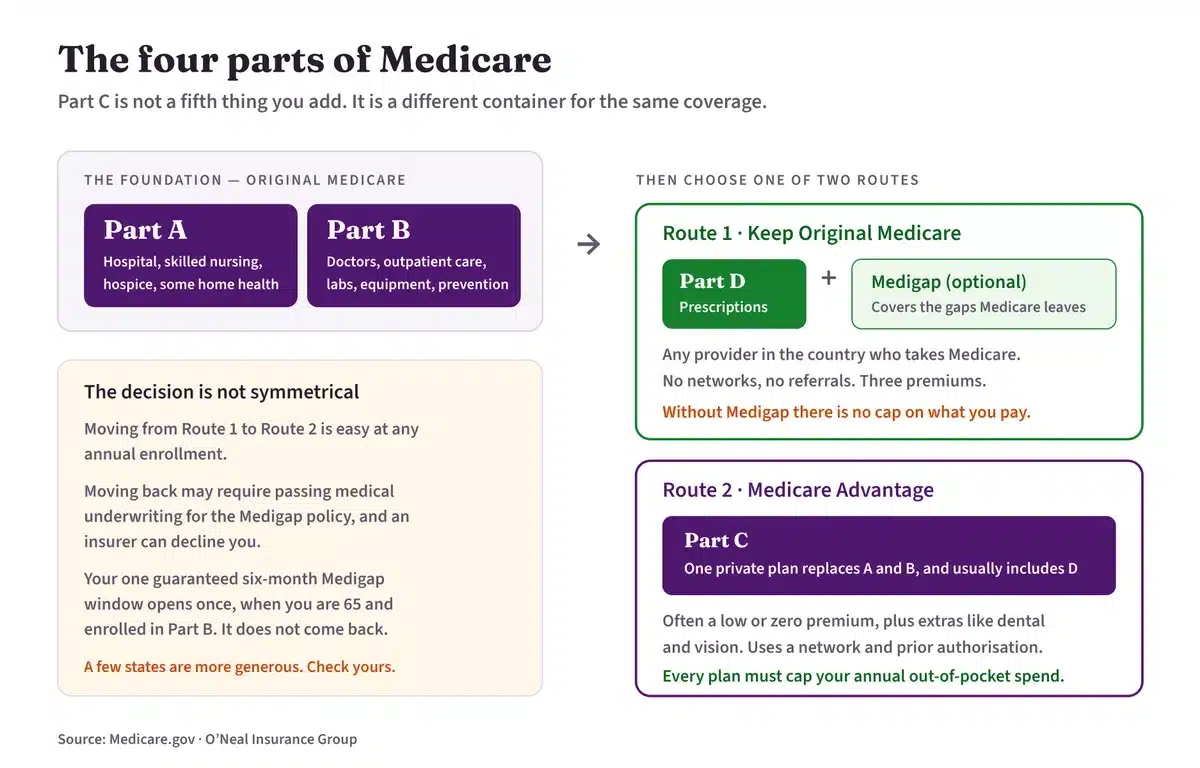
Original Medicare is the government program: Part A for hospital care and Part B for medical care. It lets you use any provider in the country that accepts Medicare, has no networks and no referrals, and has no annual limit on what you can be asked to pay.
Medicare Advantage is the same entitlement delivered by a private insurer instead. Plans must cover everything Original Medicare covers, they add an annual out-of-pocket ceiling, they usually bundle in prescription coverage and extras like dental and vision, and in exchange they use a network and often require prior authorization.
The Medicare Advantage vs Original Medicare decision is therefore a trade between freedom and a cost ceiling. Neither answer is universally right, and the honest version of this comparison says so.
What Original Medicare covers, and what it leaves open
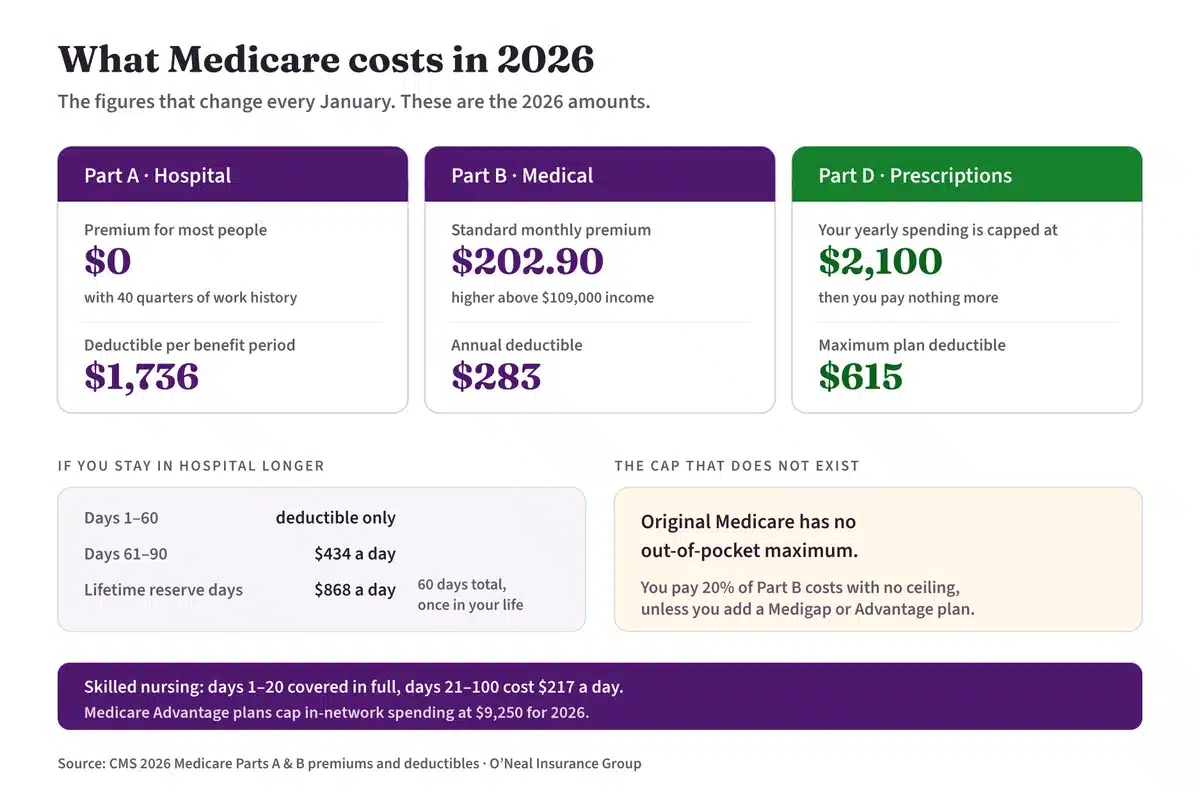
In 2026, Part A carries an inpatient hospital deductible of $1,736 per benefit period. Part B has a standard monthly premium of $202.90 — higher for higher incomes — and an annual deductible of $283, after which you generally pay 20% of the Medicare-approved amount for most services.
That 20% is the important part. It is 20% of everything, with no ceiling. For a year of ordinary care it is manageable. For a year involving chemotherapy or a long hospital stay it is not.
Original Medicare also includes no prescription drug coverage. You add a standalone Part D plan for that, and in 2026 your out-of-pocket spending on covered Part D drugs is capped once you reach $2,100.
This is why most people who stay with Original Medicare buy a Medicare Supplement policy as well. Medigap pays a defined share of what Original Medicare leaves behind and is what turns an uncapped 20% into a predictable monthly cost.
What Medicare Advantage changes
An Advantage plan replaces the way your coverage is delivered, not your entitlement. You keep paying the Part B premium, and the plan often charges little or nothing on top.
What you gain is a hard annual out-of-pocket maximum, one card instead of three, usually integrated drug coverage, and supplemental benefits — dental, vision, hearing, fitness, over-the-counter allowances — that Original Medicare does not offer at all.
What you accept is a network, which may be an HMO requiring referrals or a PPO allowing out-of-network care at higher cost; prior authorization for some services; and the fact that plans are county-specific, so the plan that suits you may not exist if you move.
Medicare Advantage vs Original Medicare, side by side
| Original Medicare (usually with Medigap) | Medicare Advantage | |
|---|---|---|
| Provider choice | Any provider in the US that accepts Medicare | Plan network, county-based |
| Referrals | None | Often required on HMO plans |
| Prior authorization | Rare | Common for imaging, surgery, skilled nursing |
| Out-of-pocket ceiling | None from Medicare itself; a Medigap policy supplies the predictability | Annual maximum set by the plan |
| Drug coverage | Separate Part D plan | Usually built in |
| Dental, vision, hearing | Not covered; bought separately | Frequently included |
| Monthly cost | Part B premium plus a Medigap premium plus Part D | Part B premium plus often little or nothing |
| Travel | Works anywhere in the country | Emergency care anywhere; routine care usually in area |
The switching problem nobody mentions upfront
This is the single most consequential thing in the Medicare Advantage vs Original Medicare comparison, and it is rarely explained before someone enrolls.
Moving from Original Medicare into an Advantage plan is easy. Moving back is easy too — but buying a Medicare Supplement policy at that point may not be. Your guaranteed right to a Medigap policy without health questions runs for six months from when you are 65 and enrolled in Part B. Outside that window, and outside a specific guaranteed-issue right, an insurer can ask about your health, charge more, or decline you.
A handful of states soften this. Nevada gives existing Medigap policyholders an annual birthday window to switch carriers without underwriting; Illinois has a narrower version for ages 65 to 75; Mississippi has none. Where you live genuinely changes how reversible this decision is.
So the practical rule is this: the Medicare Advantage vs Original Medicare choice is easiest to make at 65 and hardest to unwind at 75. Treat the first decision as the important one.
Medicare Advantage vs Original Medicare: who each route suits
Original Medicare with a supplement tends to suit people who travel or spend part of the year in another state, people with a specialist or hospital they will not give up, people with a serious ongoing condition who value predictability over a low premium, and anyone who does not want to ask permission before care.
Medicare Advantage tends to suit people whose doctors are already in a plan’s network, people who want a low monthly cost and are comfortable paying copays as they go, people who would genuinely use the dental, vision and over-the-counter benefits, and people who like having one plan and one card.
Neither list is a rule. Plenty of healthy travelers do well on a PPO, and plenty of homebodies prefer a supplement.
Four questions that decide Medicare Advantage vs Original Medicare
Four, in this order.
Are my doctors in the plan? Check every one by name, not by health system. If the answer is no and you will not change doctor, the comparison is over.
What do my prescriptions cost on each route? Price your exact list — drug, strength, frequency — on the Advantage plan’s formulary and on a standalone Part D plan.
What is my worst year? Add twelve months of premium to the plan’s out-of-pocket maximum, and compare that with twelve months of Medigap premium. That is the honest comparison, not the monthly figure.
How likely am I to want to switch later? Ask what your state allows before you assume the door stays open.
Questions we are asked about Medicare Advantage vs Original Medicare
Can I have both? No. You are on one route or the other at any given time. You also cannot hold a Medicare Supplement policy and an Advantage plan at the same time, and it is illegal for anyone to sell you one while you hold the other.
Is a $0 premium plan really free? The premium is zero; the plan is not. You still pay the Part B premium, and you pay copays and coinsurance as you use care, up to the plan’s annual maximum. On the Medicare Advantage vs Original Medicare comparison, a zero-premium plan is best read as “pay later” rather than “pay nothing”.
What if I move? Advantage plans are approved county by county, so moving out of the service area ends your enrollment and opens a Special Enrollment Period. Original Medicare moves with you anywhere in the country, which is one of the quieter arguments in its favor.
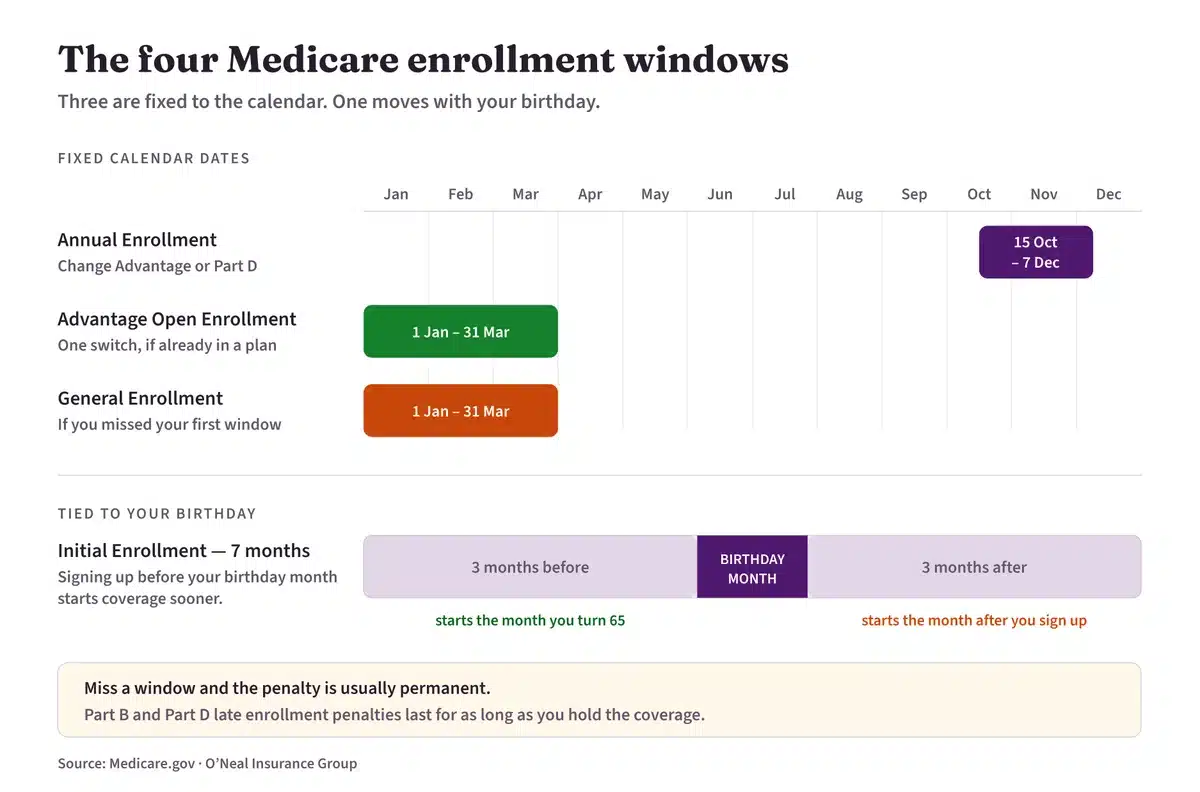
When can I switch? During the Annual Enrollment Period, October 15 to December 7. If you are already in an Advantage plan you get a second window, January 1 to March 31, to change plans or return to Original Medicare. You cannot use that second window to join an Advantage plan from Original Medicare.
Which is cheaper? Over one healthy year, usually Advantage. Over a decade including one serious illness, frequently the supplement route. That is why the Medicare Advantage vs Original Medicare question is answered with your own numbers rather than an average.
The one-year window that decides Medicare Advantage vs Original Medicare
Federal law gives you two narrow chances to undo an Advantage decision without a single health question being asked. Both are one-time only, and most people never hear about them until the window has closed.
The first applies if you joined a Medicare Advantage plan when you first became eligible for Part A at 65, and you leave it within twelve months. The second applies if you already had a Medigap policy, dropped it to try Advantage for the first time, and leave within twelve months. In either case you may buy a Medicare Supplement on a guaranteed-issue basis.
The deadline is precise. You may apply no earlier than 60 days before your Advantage coverage ends and no later than 63 days after it ends. Miss that and the protection is gone.
Read the qualifying language carefully, because it is where the trap sits. The second right requires that you enrolled in Advantage for the first time. The first requires that the enrollment happened at your initial eligibility at 65. Someone who tried an Advantage plan years ago, went back to Original Medicare, and is now considering Advantage again has no trial right left. That is a permanent, unrepeatable feature of Medicare Advantage vs Original Medicare, and it is the reason the first decision carries more weight than the annual ones that follow.
Medicare Advantage vs Original Medicare once the window closes
Outside a guaranteed-issue right, a Medicare Supplement application is medically underwritten. The insurer may ask about your health, charge more, or decline you outright. Your six-month Medigap Open Enrollment Period, the one that starts when you are both 65 and enrolled in Part B, does not come back.
Several states are more generous than the federal floor. Connecticut, New York and Massachusetts require Medigap to be available continuously; Washington lets existing policyholders move among most plan letters at any time without health screening; Rhode Island added an annual guaranteed-issue window during the Annual Enrollment Period; and about ten states run birthday or anniversary rules that reopen a short window each year. The terms differ sharply from state to state, including whether you may change insurer at all, so the only safe answer is your own state’s.
Medicare Advantage vs Original Medicare, counted properly
The first number that matters in Medicare Advantage vs Original Medicare is a missing one: Original Medicare has no annual limit on what you pay out of pocket. Medicare.gov states it plainly, and it is the structural reason supplemental coverage exists at all. A long hospital stay followed by rehabilitation and specialist infusions has no ceiling unless you have added something on top.
Medicare Advantage plans must include one. For 2026, CMS caps the in-network out-of-pocket maximum at $9,250, and PPOs at $13,900 combined in and out of network. Many plans set theirs lower. That cap is the single clearest advantage the Advantage route holds, and it is worth more than any dental or fitness benefit in a bad year.
On adoption, MedPAC reported that 55 percent of beneficiaries enrolled in both Part A and Part B were in an Advantage plan as of July 2025, around 34.9 million people. CMS, counting all Medicare enrollees including those with Part A only, projected about 48 percent for 2026. Both figures are correct; they use different denominators, which is why quoted percentages differ so widely.
Where you live changes the picture more than the national average suggests. In Clark County, Nevada, roughly 57 percent of beneficiaries are in a private plan rather than Original Medicare. In Cook County, Illinois, it is closer to 45 percent. Mississippi as a whole sits near 45 percent, though Jackson and Harrison counties on the coast run several points higher. Medicare Advantage vs Original Medicare is a genuinely local question because plan quality, networks and county availability are local.
Prior authorization, stated honestly
This is the comparison most often reported carelessly, in both directions. CMS data shows Advantage insurers handled roughly 53 million prior authorization determinations in 2024, about 1.7 per enrollee. Traditional Medicare completed just over 625,000 reviews, roughly two per hundred beneficiaries.
Here is the part that gets left out. Advantage plans denied 7.7 percent of requests; traditional Medicare denied 22.9 percent of the far smaller number it reviewed. So the honest claim is not that Original Medicare denies less often. It is that Original Medicare subjects far fewer services to review in the first place.
Of Advantage denials, only about 11.5 percent were appealed, and of those appealed, roughly 80.7 percent were overturned. A high overturn rate on a small number of appeals tells you that appealing is usually worth doing, not that most denials were wrong.
The rules are tightening. Under a federal interoperability rule finalised in 2024, affected plans must decide expedited requests within 72 hours and standard requests within seven calendar days from 2026, give a specific reason for every denial, and publish their prior authorization metrics each year. Original Medicare is not covered by that rule, because its own program is far smaller.
Where the extra benefits come from
People reasonably ask how a plan can charge no premium and still include dental, hearing and a fitness membership. The answer is that Medicare pays private plans more per enrollee than it would spend on the same person in Original Medicare. MedPAC projected that difference at about 14 percent, or roughly $76 billion, for 2026.
That is not a reason to avoid Advantage plans. It is the mechanism that funds the extras, and for many people the extras are real and useful. It is a reason to treat a $0 premium as a starting point rather than a conclusion, to read the summary of benefits rather than the mailer that arrived with it, and to compare the whole cost structure — the out-of-pocket maximum, the network, the drug tiers and the referral rules — when you weigh Medicare Advantage vs Original Medicare.
None of that requires you to distrust the plan. It requires you to compare the whole thing rather than the headline, and to do it against your own doctors, your own prescriptions and your own county rather than against a national average.
Medicare reference charts
The charts below cover the ground most questions start from.
Check any Medicare Advantage vs Original Medicare claim independently
Every figure above is published and free to verify.
- Medicare.gov — 2026 costs — the Part A and Part B figures quoted here
- Medicare.gov — Medigap — the six-month open enrollment right
- Medicare Plan Finder — compare both routes in your ZIP code
- SHIP National Technical Assistance Center — free counseling from people who sell nothing
Related guides on this site
- Medicare Advantage plans explained
- Medicare Supplement (Medigap) — every plan letter compared
- Part D prescription drug plans
- Which Medicare enrollment window applies to you
- Book a no-cost appointment
Or call (877) 808-2900. We will run the Medicare Advantage vs Original Medicare comparison with your own doctors and your own prescription list, and we are paid the same either way.
Personal guidance · No additional fee