
No additional fee · No obligation
Book an appointment with a licensed Medicare agent
Book appointment times by phone or online screen sharing, whichever suits you. There is no additional fee to you, no obligation to enroll, and no pressure to decide on the call. We start with your doctors and your prescriptions, then compare the plans available where you live.
What happens on the call
When you book appointment time with us it usually takes 30 to 45 minutes, and nothing is decided before you are ready.
- We confirm what you have now and what is changing
- We check each of your doctors against the plan networks available to you
- We run every prescription against the formularies and note the tiers
- We compare what you would actually pay, not just the premium
- If your current plan is still the best fit, we tell you so
You can book appointment slots by phone or by online screen sharing. Many people prefer screen sharing because you watch the comparison being built rather than being handed a conclusion.
Have these handy
- Your Medicare card, or the date you turn 65
- Your prescriptions, with name, dose and frequency
- The doctors and specialists you want to keep
- Your preferred pharmacy
- Your current plan name and Annual Notice of Change, if you have one
If you do not have all of it, book appointment time anyway. Most of it can be looked up together.
Book appointment: request a time
Everything except your name and phone number is optional. A licensed insurance agent will contact you about insurance.
Important: By submitting this form you are asking a licensed insurance agent to contact you about insurance. We do not offer every plan available in your area. Any information we provide is limited to those plans we do offer in your area. Please contact Medicare.gov, 1-800-MEDICARE, or your State Health Insurance Assistance Program to get information on all of your options.
Who should book appointment time, and when
There are five moments when a conversation is worth having, and one when it usually is not.
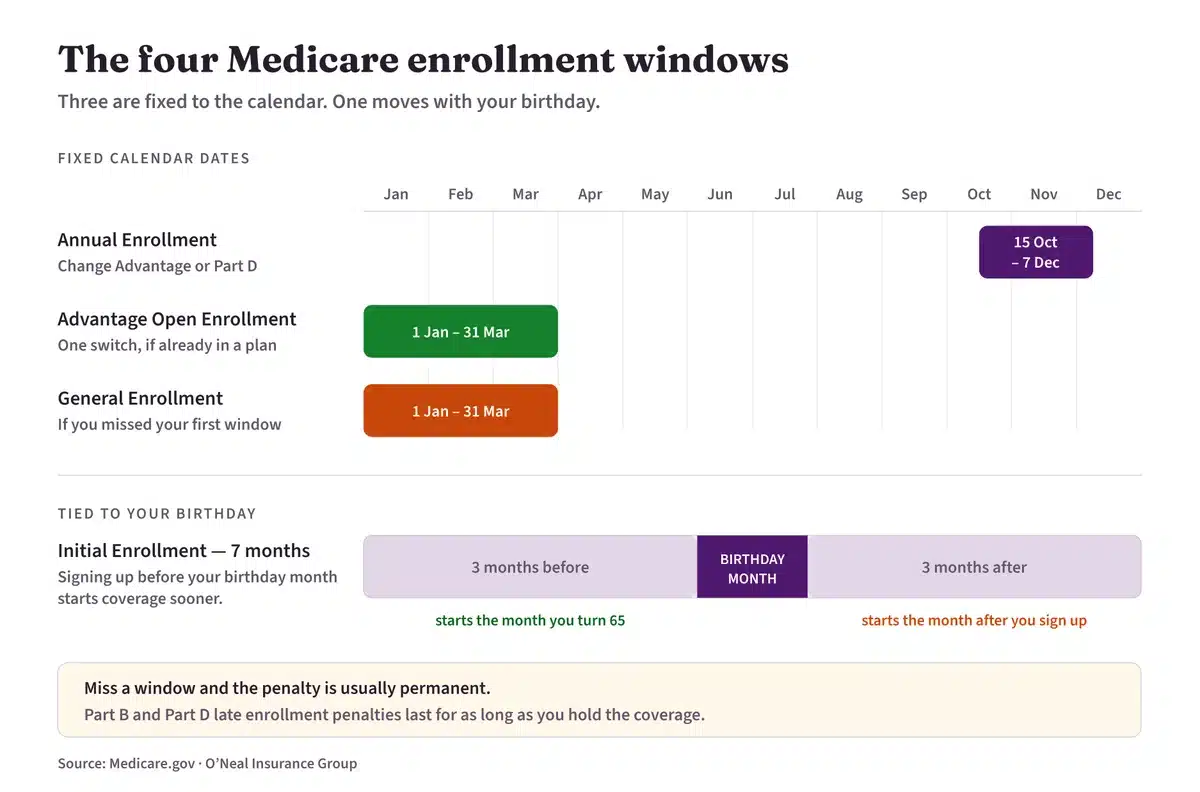
You are turning 65. Your Initial Enrollment Period runs the three months before your birthday month, the birthday month itself, and the three months after. Book appointment time early in that window rather than late, because Part B start dates depend on when you sign up.
You are still working past 65. Whether you can delay Part B without a penalty depends on the size of your employer, and getting it wrong is expensive for life. This is the single most valuable call on the list.
Your Annual Notice of Change has arrived. Every autumn your plan tells you what will be different on January 1. If your premium, your drug tiers or your out-of-pocket maximum have moved, book appointment time before December 7.
Something has changed at your end. A move, a new diagnosis, a new prescription, a doctor leaving the network, losing employer coverage, or being approved for Medicaid or Extra Help. Several of these open a Special Enrollment Period.
You want a second opinion. Perfectly good reason. Plenty of appointments end with “keep what you have”.
The one time it is not worth it: you received a postcard saying your plan is being discontinued and you want to know if it is true. Call the number on your plan card first, or ring 1-800-MEDICARE. Those mailers are frequently marketing rather than fact.
What it costs, and how we are paid
Nothing, and it does not change your premium. Plan prices are set by the insurer and filed with regulators, so they are identical whether you enroll through an agent, through the carrier’s own phone line, or by yourself at Medicare.gov. There is no broker fee.
We are paid a commission by the insurance company when someone enrolls. For Medicare products the rates are set by federal rules rather than by carriers competing for a recommendation, which is worth knowing because it means we have no financial reason to steer you toward one insurer over another.
It also means that if the plan you already hold is the right one, we earn nothing by telling you so. We will still tell you.
By phone, or by screen share
Both take the same amount of time and cost the same, which is nothing.
By phone suits people who know what they want to ask, or who would rather not deal with a link. You can book appointment slots for a phone call at any time in the working day.
By screen share means you watch the comparison being built rather than being handed a conclusion. You see your own drug list priced across plans, and your own doctors checked one by one. It works on a phone, tablet, laptop or desktop, and it does not require you to install anything complicated.
Most people who have done it once ask for screen share the second time. Family members can join either format, and often should — two people remember more of it than one.
What we cannot do for you
We are a licensed insurance brokerage, not a government office.
We cannot determine your eligibility for Medicaid, Extra Help or a Medicare Savings Program — only your state agency and the Social Security Administration can. We cannot enroll you in Part A or Part B; that happens at ssa.gov. We do not give medical, tax or legal advice, and we cannot reverse a coverage decision a plan has already made.
We also do not offer every plan available in your area. Where a question belongs somewhere else, you will get the right phone number rather than an opinion.
Keeping your information safe
Nobody legitimate cold-calls about Medicare, and nobody legitimate asks for your Medicare number, Social Security number or bank details out of the blue. Medicare does not sell plans by telephone.
Do not send Social Security numbers, Medicare numbers, financial information or medical records by ordinary email, text message or social media. Use the form on this page, the secure enrollment link, or the phone.
You can verify any agent’s license through your state insurance department, all of which are listed by the NAIC. Do that before you share anything with anybody, including us.
Questions people ask before they book appointment time
How long does it take? Thirty to forty-five minutes for a full review. A quick question takes five.
Will I be pressured to enroll? No. Nothing is submitted without you asking for it, and you will not be put on a follow-up list you did not agree to.
What if I do not have my prescription list? Book appointment time anyway. Most of it can be looked up together, and a partial list today beats a complete one in December.
Can I bring my daughter or son? Yes, on either format, and it is usually a good idea.
Do I have to change anything? No. “Stay where you are” is a common and perfectly good outcome.
What if I am not on Medicare yet? Still worth it. Individual and family health insurance, life insurance and supplemental cover are all part of what we do.
Is there a best time of year? Any time works for a conversation. If you want to change a Medicare Advantage or Part D plan, the Annual Enrollment Period from October 15 to December 7 is when most changes can be made, so book appointment time in late October or early November rather than in the last week.
Medicare reference charts
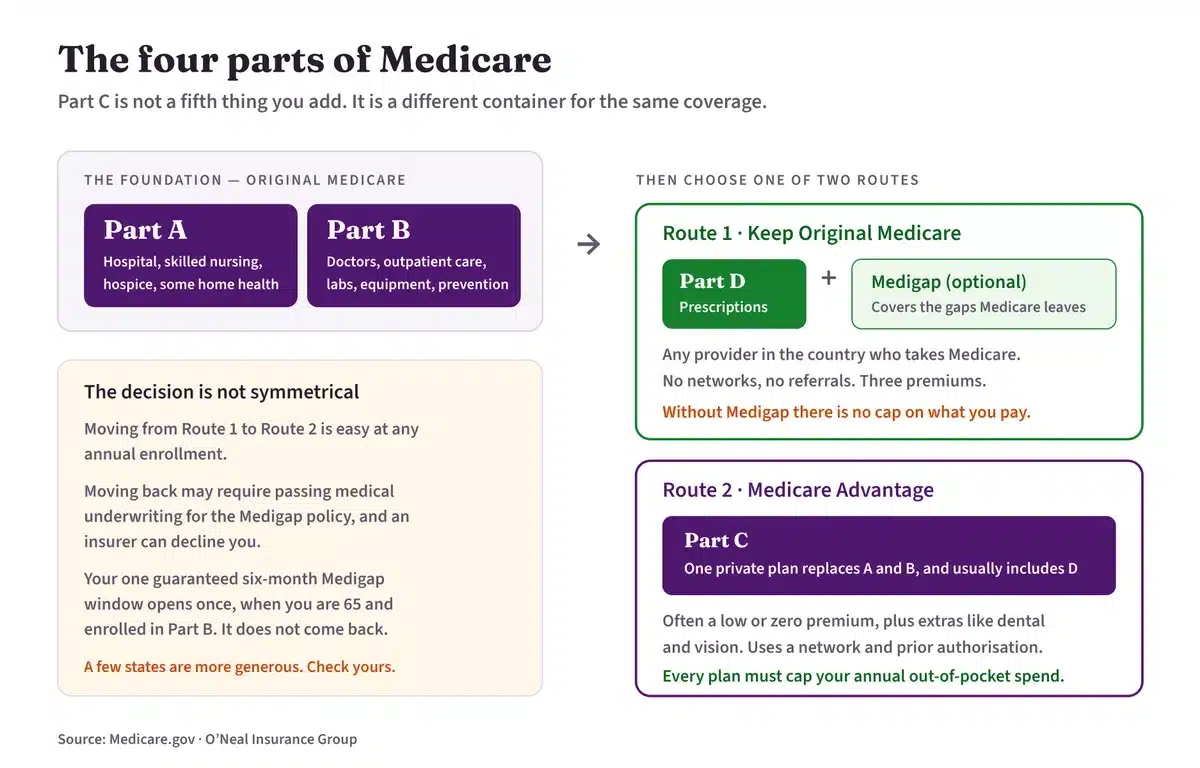
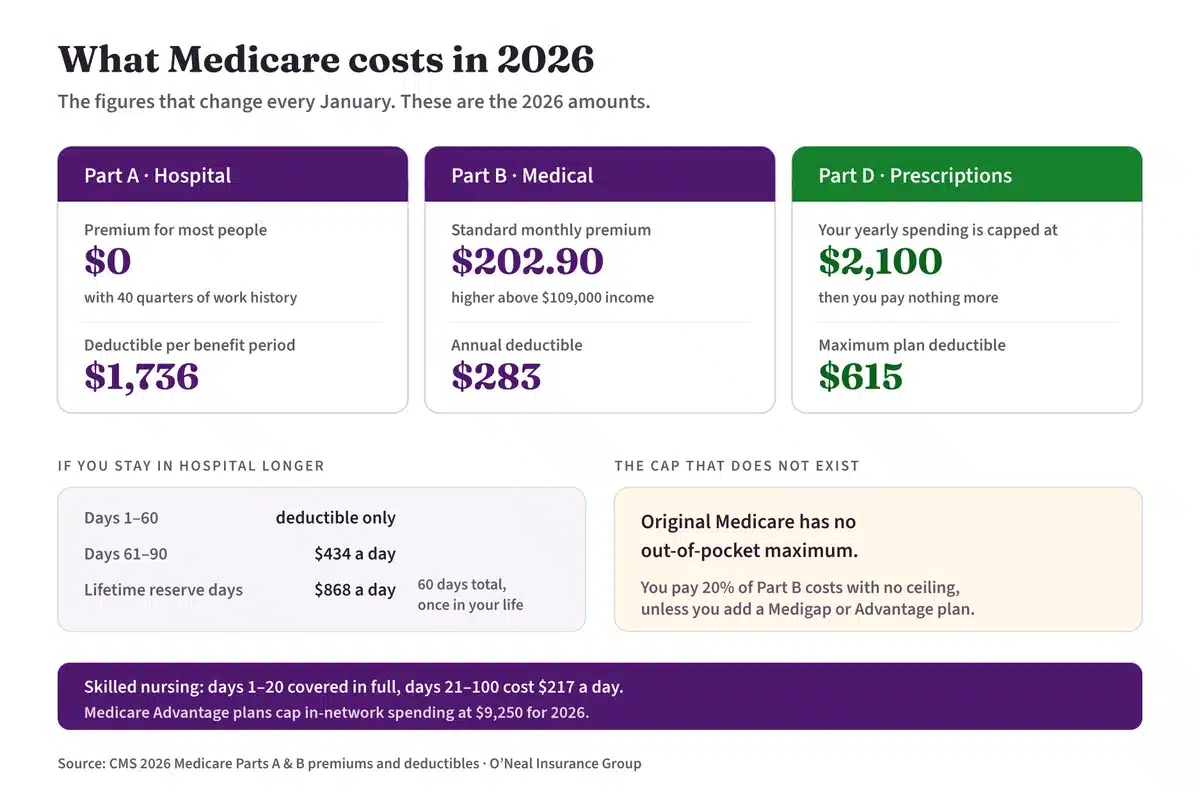
The charts below cover the ground most questions start from.
What happens after the appointment
The enrollment is the short part. The month that follows it is where problems surface, and knowing the sequence means you spot them early.
The first 48 hours
You should receive a confirmation number at the point of enrollment. Write it down. If you enrolled by telephone, the call was recorded, which is a protection rather than an intrusion — it is the record of exactly what was described to you.
Nothing has changed about your existing coverage yet. Enrollments take effect on a date, usually the first of a month, and until that date arrives you are still on whatever you held before.
The first few weeks
Medicare has to confirm the enrollment before the plan can finalise it, so an acknowledgement letter usually arrives before the membership card does. If you have heard nothing at all after two weeks, that is the point to chase rather than to wait.
When the card arrives, check three things on it before filing it away: your name spelled correctly, the effective date you agreed, and the plan name matching what you chose. Errors at this stage are easy to fix and tedious to fix later.
You should also receive an Evidence of Coverage, which is the full contract rather than the summary. Nobody reads it end to end. Do read the sections on prior authorization and on how to appeal a refusal, because those are the two things you will want to know in a hurry if you ever need them.
The first time you actually use it
The pharmacy counter is where most surprises appear, because a formulary is abstract until a prescription is filled against it. Take the new card on the first visit after your effective date and check what you are charged against what you were told.
If a medication costs more than expected, do not simply pay it and move on. There are usually options — a different tier, a preferred pharmacy, a formulary exception, or a prescriber note supporting the drug you were already stable on. All of them take a phone call and none of them happen automatically.
The same applies at the first specialist visit. If a provider you were told was in network says otherwise, ring us before paying anything, because that is a discrepancy worth resolving rather than absorbing.
And then for the rest of the year
A good appointment is not a transaction that ends when the paperwork does. Three moments in the year are worth a note in the diary.
By September 30, your plan must send an Annual Notice of Change setting out what will differ from January 1 — drug tiers, copays, the out-of-pocket maximum and the provider network. It is the single most useful document you receive all year and the one most often binned unopened.
Between October 15 and December 7 you can act on it. And if you are in a Medicare Advantage plan on January 1, you get one further change between then and March 31.
Nothing obliges you to book appointment time again in any of those windows. If the plan still fits, the right answer is to leave it alone, and we will say so. But a five-minute call each autumn costs nothing and catches the changes that would otherwise arrive as a surprise in February.
If something changes before then — a move, a new diagnosis, a medication added, losing or gaining other coverage — that is also a reason to book appointment time rather than wait for autumn, because several of those open a Special Enrollment Period with a deadline attached.
When to book appointment time, and when to leave it
Not every situation needs a meeting, and we would rather say so than fill a diary. Four situations genuinely warrant one.
You are approaching 65. The best time to book appointment time is about three months before your birthday month, while the Initial Enrollment Period is still open ahead of you rather than closing behind you.
You are retiring or losing employer coverage. The window that opens when that coverage ends is time-limited and the forms need an employer signature, so book appointment time before the last day rather than after it.
Something changed. A move, a new diagnosis, a medication added, a doctor leaving your network. Any of those can make a plan that suited you last year the wrong one now.
Your Annual Notice of Change worries you. That letter arrives by September 30, and it is the commonest reason people book appointment slots in October.
And one situation where you should not bother. If nothing has changed in your health, your medications or your doctors, and the notice shows no meaningful change either, the plan you hold is probably still right. You do not need to book appointment time to be told that, though you are welcome to ring and hear it in two minutes.
The practical case for booking early
Between October 15 and December 7 every agent in the country is busy at once. The work is identical in August and the attention is not, so people who book appointment time outside that window get a slower, better conversation.
Enrollment itself cannot happen before the window opens, but the comparison can. Arriving in October with the work already done is the difference between a decision and a scramble.
There is no fee to book appointment time, no obligation to enroll at the end of it, and no charge if you decide to stay exactly where you are.
If you are helping a parent, book appointment time with them present rather than on their behalf. We cannot discuss someone else’s Medicare account without an authorization on file, and the form takes longer to arrange than the meeting does. Bring it, or book appointment time for a date after it has been filed.
Check any of this independently
All of these are free and none of them sell anything.
- Medicare Plan Finder — compare every plan in your ZIP code yourself
- SHIP National Technical Assistance Center — free one-to-one counseling in your state
- Social Security — where Part A and Part B enrollment happens
- NAIC consumer tools — agent license and carrier complaint lookup
Related guides on this site
- Which Medicare enrollment window applies to you — read this before you book appointment time if you are unsure you can act
- What to bring to a Medicare plan review
- How we help — and how we are paid
- Prefer to do it yourself? — compare and enroll online, with us behind you
- The four offices and areas served
Personal guidance · No additional fee
Prefer to just call?
You can reach a licensed agent directly, and book an appointment for a longer review if you want one.