
One-on-one, by phone or screen share
Help with Medicare from O’Neal Insurance Group
James gives one-to-one help with Medicare: understanding it, comparing represented options, joining and enrolling, using the priorities and information you provide.
How an appointment for help with Medicare actually goes
- 1
You tell us your situation
Doctors, prescriptions, travel, budget, what worries you. Fifteen minutes, no forms. That is where every piece of help with Medicare we give starts, because nothing sensible can be recommended without it.
- 2
We narrow the field
We check networks against your providers and price your exact drug list across the plans available to you.
- 3
You see it side by side
Two or three real options with the trade-offs written down — including the case for keeping what you have.
- 4
We stay reachable
If you enroll, we handle the application and remain your contact for claims, bills and next year’s review. Help with Medicare does not end at the signature, and there is never a second fee for calling us back.
Medicare
If you’re new to Medicare, start with the basics page and work outward.
Medicare basics
Parts A, B, C and D, and the one big decision.
Medicare Advantage (Part C)
Bundled private plans with networks and extras.
Medicare Supplement (Medigap)
Predictable costs, any Medicare provider.
Part D drug plans
Formularies, tiers and the $2,100 yearly cap.
Medicare & Medicaid
D-SNPs, Savings Programs and Extra Help.
Veterans & Medicare
How VA care and Medicare fit together.
Life insurance
Term, whole, universal and final expense — different tools for different jobs.
Coverage that fills the gaps
These are supplemental policies, and they are one of the areas where impartial help with Medicare matters most. They do not replace health coverage — they pay for things health coverage leaves behind, usually in cash directly to you.
Dental insurance
Cleanings, fillings, crowns and dentures — none of which Original Medicare covers.
Vision insurance
Routine eye exams, frames, lenses and contacts.
Cancer insurance
A cash benefit on diagnosis, for the costs treatment brings that insurance doesn’t bill for.
Critical illness
A lump sum after a heart attack, stroke or other covered condition.
Hospital indemnity
Pays a fixed amount per day in the hospital — often paired with a Medicare Advantage plan.
Individual and family health insurance and Medicaid guidance now have full pages of their own. Disability income and long-term care are also part of what we do, and we give the same help with Medicare customers ask for on either. Ask about any of them today.
What help with Medicare actually looks like
People arrive here with one of three problems. They are turning 65 and do not know what to do first. They have a plan and something about it has stopped working — a doctor left the network, a drug moved tier, a bill arrived that should not have. Or the Annual Notice of Change landed in October and the plan they were happy with has quietly changed.
All three need the same first step: somebody who will look at your specific doctors, your specific prescriptions and your specific budget rather than describing plans in general. That is the whole of what we mean by help with Medicare. It is not a sales presentation, and there is no version of it where you are asked to decide on the call.
Most appointments take between twenty and forty minutes. They happen by phone or screen share, and you can have a family member on the line.
What it costs you, and how we are paid
Nothing. Every plan we can sell you is priced by the insurer and filed with regulators, and that price is identical whether you enroll through us, through the carrier’s own phone line, or by yourself on Medicare.gov. There is no broker fee and no markup.
We are paid a commission by the insurance company when someone enrolls, and the amount is set by federal rules rather than by the carrier competing for our recommendation. We think you should know that rather than wonder about it, because the honest version of help with Medicare includes telling you who pays us.
Two consequences worth being clear about. We are paid only if you enroll in something, so if you already have the right plan we earn nothing from telling you so — and we will still tell you so. And we do not represent every insurer, which is why every page on this site points you to Medicare.gov and your state’s free counseling service as well.
What we can and cannot do
We can price your exact drug list across every plan available to you, check each of your doctors by name against plan networks, explain the trade-off between Medicare Advantage and a Medigap policy in your state, handle the application, and stay reachable afterwards for claims questions, billing problems and next year’s review.
We cannot determine your Medicaid eligibility, override a coverage decision, give medical, tax or legal advice, or sell you a plan from a carrier we do not represent. When a question belongs somewhere else, the useful form of help with Medicare is a phone number, not an opinion — and we will give you the number.
We also will not enroll anyone over the phone who does not clearly want the plan being discussed. If you need a week to think, take the week.
Questions to ask before you accept help with Medicare from anyone
These apply to us as much as to anyone else who calls you.
Are you licensed in my state, and what is your license number? Any legitimate agent will answer immediately. You can verify it with your state insurance department.
Which carriers do you represent? An agent who represents three carriers cannot show you the fourth, and should say so without being pushed.
How are you paid? The answer should be specific.
Will you check my drugs and doctors individually, or show me a general comparison? Real help with Medicare is specific to your list. A generic brochure comparison is not the same thing.
Who do I call next year? An agent of record who answers their own phone is worth more than a slightly better first-year deal from someone you will never reach again.
And one thing to watch for in reverse: nobody legitimate cold-calls you about Medicare, and nobody legitimate asks for your Medicare number, Social Security number or bank details out of the blue. If a call starts that way, hang up.
Free help with Medicare that does not come from an agent
We are not the only option, and for some questions we are not the best one. These services are free, independent, and sell nothing.
Your State Health Insurance Assistance Program (SHIP). Trained counselors who give one-to-one help with Medicare at no cost and have no product to place. If you want a second opinion on anything we tell you, this is where to get it.
1-800-MEDICARE. The official line, open 24 hours a day, for coverage questions, replacement cards and complaints.
Your state Medicaid office. The only body that can determine eligibility for Medicaid, the Medicare Savings Programs, or Extra Help with drug costs.
Social Security. Where Part A and Part B enrollment actually happens, and where an income-related premium adjustment is appealed.
Using all of them alongside us is not a problem. It is what we would do.
Why the first published numbers deserve a second look
This is the least glamorous part of what we do and probably the most valuable, so it is worth explaining properly.
Plan data for the coming year lands on Medicare.gov in early October, a fortnight before Annual Enrollment opens. It is an enormous data drop — every plan, every county, every drug on every formulary — and in its first days it is not always right.
That is not a rumour. Consumer advocates have documented the Plan Finder showing drastically inflated costs for some drugs, different prices for the same drug on the same plan, incorrect premiums for people receiving Extra Help, and formulary details that did not match the plan. When the provider directory was rebuilt for 2026, the problems were serious enough that a doctor could show as in network at one address and out of network at another under the same plan.
CMS took that last one seriously enough to create a rescue hatch. For 2026, anyone who enrolled in a Medicare Advantage plan through the Plan Finder, with a start date between January 1 and December 1, and then discovered within their first three months that their preferred doctor was not actually in the network, can change plans by calling 1-800-MEDICARE and explaining what happened. Most people who need it have never heard of it. Ask us whether it still applies to your year before you assume you are stuck.
What we do about it
Four things, none of them clever, all of them worth the time.
We wait a few days. The obvious errors get corrected in the first week or two of October. Quoting from day-one data and enrolling somebody on October 16 is how people end up in the wrong plan through nobody’s fault.
We confirm networks with the practice. Not the directory, not the health system — the office that answers the phone. It takes a few minutes and it is the single most common thing the published data gets wrong.
We price drugs against the plan’s own documents. If the Plan Finder and the plan’s formulary disagree, the formulary is the one that will be applied to you in January.
We look across plans, not at one. Seeing the same plans priced for many households in the same county is how an anomaly becomes obvious. One quote in isolation looks like a number; twenty quotes make a wrong one stand out.
None of this is a reason to distrust Medicare.gov. It is the official source, it is free, and you should use it — our compare and self-enroll page points you straight at it. It is a reason to check twice before December 7, because after that the decision is generally fixed until the following autumn. Getting help with Medicare at the point where the data is still settling is worth more than getting it in January when it is too late to act.
If you take one thing from this page: read the Annual Notice of Change your plan must send you by September 30, then check the numbers again in the second half of October rather than the first. Or let us do that part for you, at no cost, which is the whole reason this kind of help with Medicare exists.
Medicare reference charts
The charts below cover the ground most questions start from.
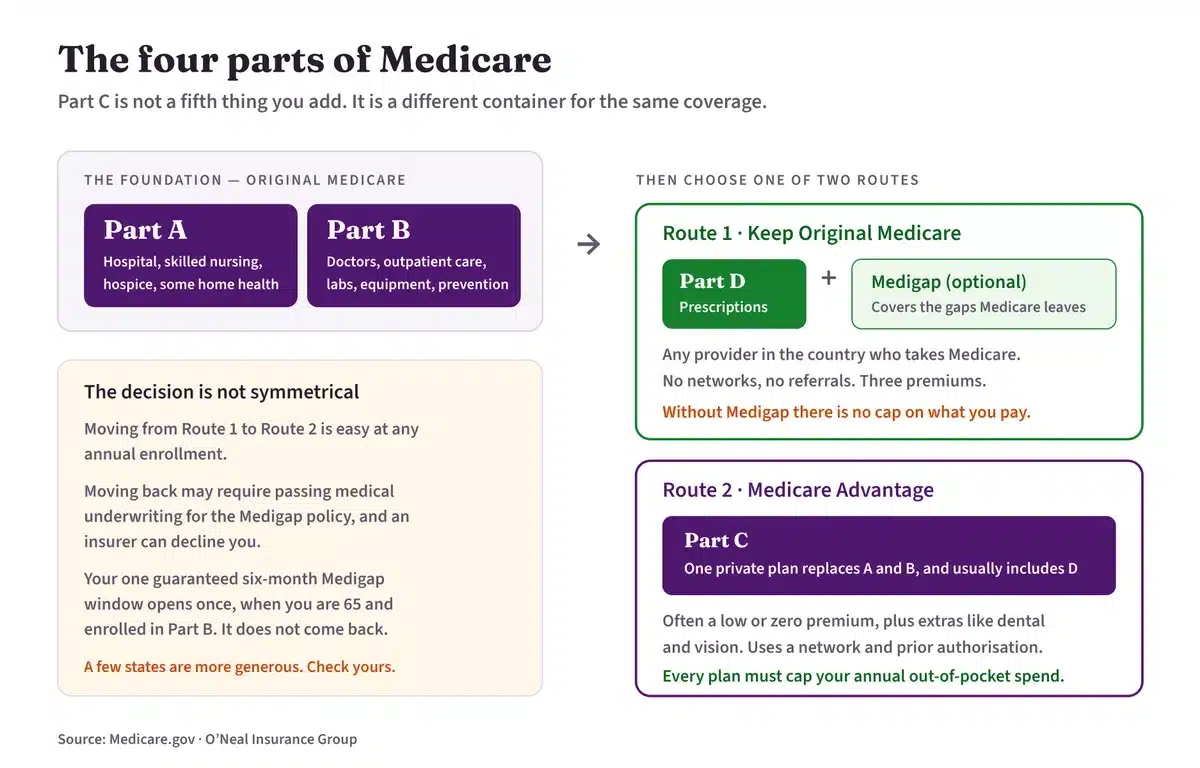
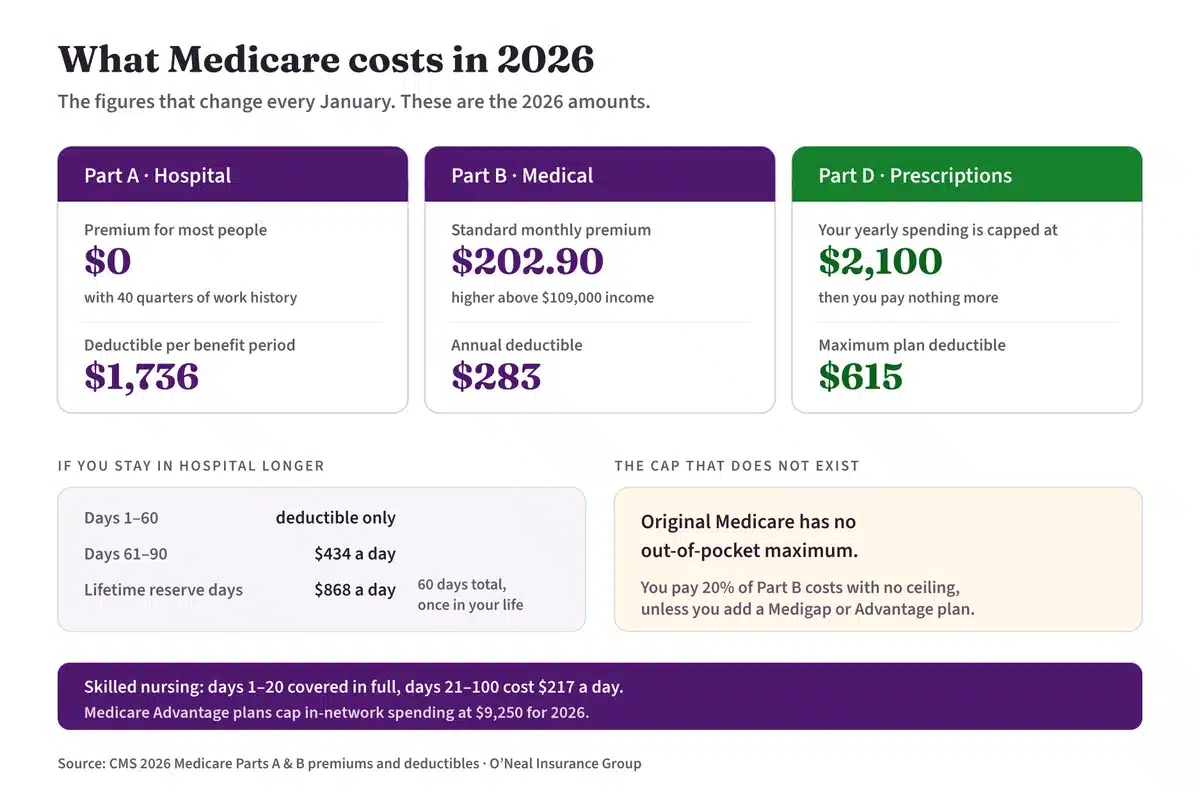
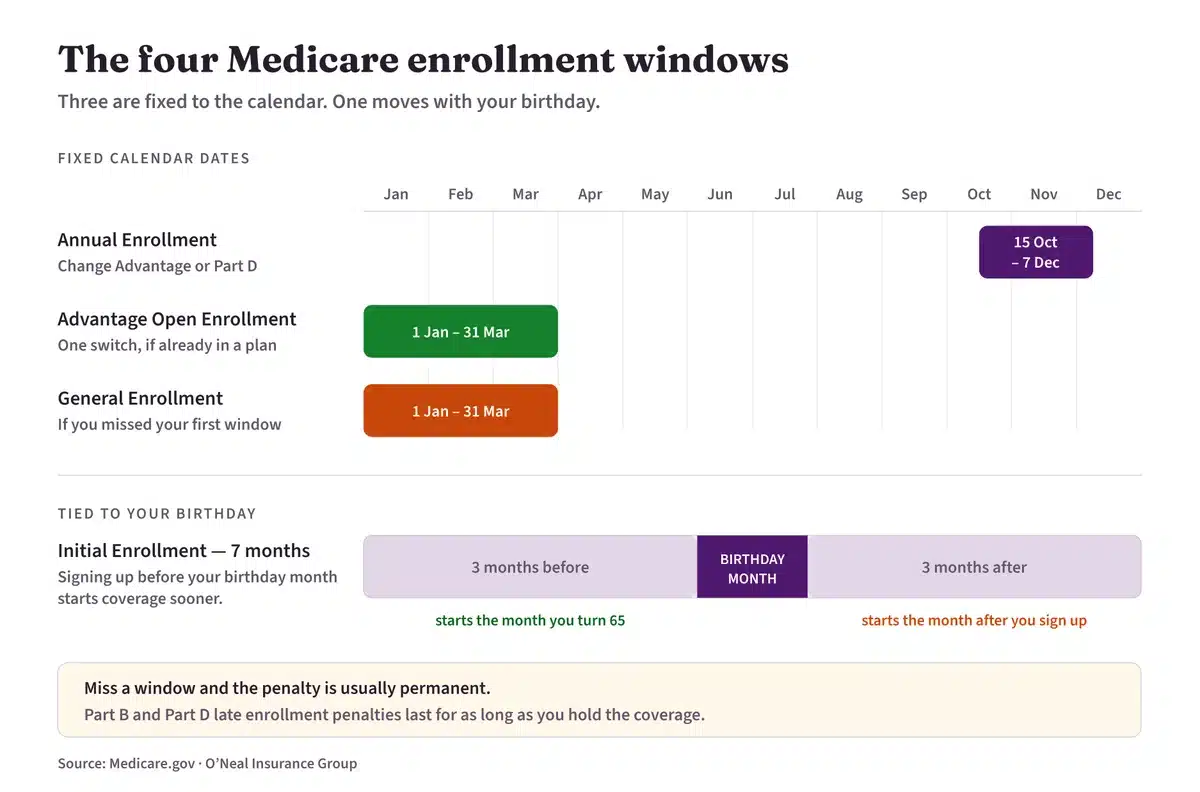
What a review usually turns up
People expect a plan recommendation. More often the useful output is something smaller and more specific, and five findings account for most of it.
A medication on the wrong tier. The commonest single finding. A drug that costs a few dollars on one plan and a great deal on another, usually because of tier placement rather than the premium. This is why the medication list with doses matters more than anything else you bring.
A pharmacy that is in network but not preferred. Both are covered. The copay difference repeats every month, and switching counters is often the whole saving.
An assistance program nobody mentioned. Income near the Medicare Savings Program or Extra Help limits, never checked. Qualifying changes every other number on the page, which is why we ask about it before discussing plans at all.
A supplement decision made without knowing it was one-way. Moving into an Advantage plan is easy at almost any time. Moving back to a supplement later can mean health questions and a refusal. People are entitled to know that before they choose, not afterwards.
A plan that quietly changed. The Annual Notice of Change arrives by September 30 and alters drug tiers, copays, the out-of-pocket maximum or the network. Doing nothing enrolls you in next year’s version, not this year’s.
None of those require switching anything. Two of them are usually fixed with a phone call, and the honest outcome of help with Medicare is often that the plan you hold is still the right one.
That is worth saying plainly, because it is the outcome an agency has the least financial reason to reach and the most reason to be trusted for. Genuine help with Medicare includes telling you when to do nothing.
What we deliberately do not do
An agency that is vague about its limits is harder to trust, not easier, so here they are. We do not determine eligibility for Medicaid, Extra Help or the Savings Programs — only the relevant agency does that, and we will point you to it. We do not give medical advice, and we will not tell you whether a treatment is worth having. We do not give tax advice, which matters when income-related premium adjustments are in play.
We also do not offer every plan available in your area, and we will say so when something worth considering sits outside what we can sell. Real help with Medicare includes naming the thing you should look at elsewhere.
Two of those five findings are usually settled inside the appointment itself, which is why help with Medicare is worth asking for even when nothing appears to be wrong. The other three are worth a diary note, because they surface at predictable moments in the year.
There is no fee for any of it, and no obligation to move anything. Help with Medicare that arrives with a conclusion already decided is not advice, it is a sales call with better manners.
Check any of this independently
Verify us, and verify anyone else.
- Medicare.gov — the official program site and plan finder
- SHIP National Technical Assistance Center — free counseling in your state
- NAIC consumer tools — agent license lookup and carrier complaint records
- SSA.gov — sign up for Medicare — where Part A and Part B enrollment happens
- CMS — special enrollment period for incorrect Plan Finder provider information — the rescue hatch described above, in CMS’s own words
Related guides on this site
- Which Medicare enrollment window applies to you — start here if you are not sure you can act yet
- New to Medicare and turning 65
- Medicaid, Medicare Savings Programs and Extra Help
- Compare plans and enroll yourself — with us behind you at no cost
- Book a no-cost appointment
Or call (877) 808-2900. Ask whatever you like. There is no obligation and no cost for help with Medicare, we do not put anyone on a follow-up list they did not ask to be on, and we would far rather answer a question well than sell somebody the wrong plan.
Personal guidance · No additional fee