
Licensed insurance agent and broker
James O’Neal, licensed Medicare agent and broker
James O’Neal is a licensed insurance agent and broker who helps people compare Medicare plans, health coverage, life insurance and supplemental products. The approach is simple: start with your doctors and your prescriptions, then look at plans. Never the other way around.
How James O’Neal works with clients
Every review starts the same way. Your doctors by name, your prescriptions with doses, and what you actually want from your coverage this year.
Only after that does the conversation turn to plans. It is a slower start than most people expect, and it is the reason the recommendation holds up in March rather than falling apart the first time you need a specialist.
You will also hear when your current plan is already the right one. That answer comes up often, and it is given freely.
What James O’Neal can help with
- Medicare plan comparisons, including Medicare Advantage, Medigap and Part D
- First-time enrollment for people turning 65
- Medicare and Medicaid together, and VA coordination for veterans
- Annual reviews when a plan changes its network, formulary or costs
- Life, dental, vision and supplemental coverage
Licensing and how the help is paid for
James O’Neal is a licensed insurance agent and broker appointed by multiple carriers, working through an agency that is Medicare-licensed across 30 states and Washington, D.C., with offices in Las Vegas, Chicago, Hattiesburg and Ocean Springs. Our locations page lists the offices and areas served.
There is no additional fee to you. Agents may be compensated by an insurance carrier when an enrollment occurs, and your premium is the same whether you enroll through an agent, directly with the carrier, or on your own.
You can verify any agent license through your state insurance department, all of which are listed by the National Association of Insurance Commissioners. Our page on finding a local licensed Medicare agent explains what to ask.
How to reach James O’Neal
Phone, online screen-sharing, or in person. Many people prefer the screen-sharing appointment because you watch the comparison being built rather than being handed a conclusion.
Bring your Medicare card, a list of your doctors, and a list of your prescriptions with doses. If you do not have all of it, come anyway.
Important: We do not offer every plan available in your area. Any information we provide is limited to those plans we do offer in your area. Please contact Medicare.gov, 1-800-MEDICARE, or your State Health Insurance Assistance Program to get information on all of your options.
What an appointment with James O’Neal actually involves
Appointments with James O’Neal run twenty to forty minutes. They happen by phone or screen share, and family members are welcome on the line. There is nothing to sign and nothing to decide on a first call.
You describe the situation. Which doctors you want to keep, what you take and at what dose, whether you travel, what you can afford, and what has gone wrong before. Fifteen minutes, no forms.
The field gets narrowed. Your drug list is priced across every plan available in your county, and each provider is checked individually rather than by health system — because a system can be in network while a particular practice inside it is not.
You see two or three real options. Written down, with the trade-offs stated, including the case for keeping the plan you already have.
You decide in your own time. If you enroll, the application is handled for you, and James O’Neal remains your point of contact afterwards for claims questions, billing problems and next autumn’s review.
What to have ready for James O’Neal
None of this is mandatory, and an appointment is still worth having if you only have some of it. James O’Neal would rather see a partial list today than a complete one in December.
- Your Medicare card, for your Part A and Part B start dates
- Your permanent ZIP code and county — plans are approved county by county, not statewide
- Every doctor and specialist you want to keep, by name
- Every prescription with the exact strength and how often you take it
- Your preferred pharmacy, since preferred and standard pharmacies price the same drug differently
- Any Medicaid, Extra Help, VA, TRICARE, retiree or employer coverage you already hold
The prescription list is the one that changes the answer most. “A blood pressure tablet” cannot be priced. “Lisinopril 10mg once daily” can.
What James O’Neal will not do
Being clear about the limits is part of the job.
He will not determine your eligibility for Medicaid, Extra Help or a Medicare Savings Program — only your state agency and the Social Security Administration can do that. He will not give medical, tax or legal advice. He cannot overturn a coverage decision a plan has already made, and he cannot sell you a plan from a carrier the agency does not represent.
He will not enroll anyone over the phone who has not clearly said they want the plan being discussed, and he will not put you on a follow-up list you did not ask to be on. Where a question belongs with a government office, you will be given the number rather than an opinion.
You will also be told when the plan you already hold is the right one. That answer earns nothing and is given freely, which is the only reason it is worth anything.
How to verify any licensed agent, including this one
You should not take a license claim on trust from a website, and that includes this website.
Every state insurance department maintains a public license lookup, and all of them are listed by the National Association of Insurance Commissioners. The same lookup usually shows complaint records against carriers, which is worth checking before you buy from any insurer.
Four questions settle most of it with anybody, James O’Neal included. Are you licensed in my state, and what is the license number? Which carriers do you represent, and which do you not? How are you paid? And who do I call next year? An agent who answers all four without hesitation is usually the one to work with.
One thing to watch for in reverse: nobody legitimate cold-calls about Medicare, and nobody legitimate asks for your Medicare number, Social Security number or bank details out of the blue. If a call starts that way, hang up.
Free help that does not come from an agent
An independent agent is not the only route, and for some questions it is not the best one. These are free, sell nothing, and are worth using alongside any agent.
- Your State Health Insurance Assistance Program — trained counselors, one to one, at no cost
- Medicare Plan Finder — compare every plan in your ZIP code yourself
- Social Security — where Part A and Part B enrollment actually happens
- 1-800-MEDICARE, 24 hours a day, for anything official
Using all of them and still calling James O’Neal is not a contradiction. It is what a careful person does.
Questions people ask before booking James O’Neal
Does it cost anything? No, and it does not raise your premium. Plan prices are filed with regulators and are identical whether you enroll through an agent, through the carrier, or by yourself.
How is James O’Neal paid, then? A commission from the insurance company when someone enrolls, at rates set by federal rules rather than by carriers competing for a recommendation. If you already have the right plan, there is no commission — and you will still be told.
Do I have to meet in person? No. Most appointments are by phone or screen share. The offices in Las Vegas, Chicago, Hattiesburg and Ocean Springs are available if you prefer, but nothing requires a visit.
Can my daughter or son sit in? Yes, and it is often a good idea. Two people remember more of it than one.
What if I only want a second opinion? That is a perfectly good reason to call. Plenty of appointments end with “your current plan is fine” and nothing else happens.
The situations people actually call about
Almost nobody rings James O’Neal to browse. They ring because something specific has happened, and the same handful of situations come up again and again.
Turning 65 while still working
The question is almost never which plan. It is whether to take Part B at all yet, and that turns on the size of the employer. Twenty or more employees and the group plan generally pays first, so Part B can wait. Fewer than twenty and Medicare pays first from the month you are eligible, which means a group plan may pay very little on claims Medicare would have covered.
People usually discover that from a denied claim. It is a five-minute conversation beforehand and an expensive one afterwards, which is why James O’Neal would rather have it early.
Retiring or losing employer coverage
Leaving employer coverage opens an eight-month Special Enrollment Period for Part B, claimed with forms CMS-40B and CMS-L564 — the second signed by the employer. COBRA does not extend that window, and a great many people assume it does.
The paperwork is the part that takes time, not the plan choice, so bring the retirement date to James O’Neal rather than only the birthday.
Moving, or spending part of the year elsewhere
Plans are filed county by county. A move out of your plan’s service area is a qualifying event, and telling the plan before you go gives you a longer window than telling it afterwards. Miss it entirely and the plan will eventually disenroll you, dropping you into Original Medicare without drug coverage.
Spending months away is a different question with a different answer, and it usually comes down to whether a network follows you. This is one of the more common reasons people ask James O’Neal to look at Original Medicare with a supplement rather than an Advantage plan.
A new diagnosis, or a specialist worth protecting
When a consultant matters, the network check stops being administrative. A carrier contracts separately with a hospital, with the physicians it employs, with independent groups practising there and with its outpatient sites, so a directory listing the building settles very little.
Prior authorization deserves the same attention, because it decides how easily imaging, infusions or surgery get approved. Ask how a refusal is appealed and how long a decision takes.
Helping a parent
Get the paperwork right first. Medicare will not discuss an account with you until an authorized representative form is on file, and each plan needs its own authorization. A power of attorney is not automatically enough.
Where possible, have the parent on the call with James O’Neal. It is faster, and it avoids a second appointment while forms are filed.
Money is tight
This one is checked before anything else, because qualifying changes every other answer. The Medicare Savings Programs pay the Part B premium and, at the top level, deductibles and coinsurance too. Extra Help covers most of a drug plan premium and holds copays to a few dollars.
Applying costs nothing and commits you to nothing, and qualifying for a Savings Program brings full Extra Help automatically. It is the first question James O’Neal asks when the numbers look tight, not the last.
If none of those describe you and your current plan still works, that is a perfectly good outcome. James O’Neal will say so, and there is no fee for hearing it.
What happens in the eleven months after the paperwork
Enrollment is the short part. The work that decides whether a plan was the right choice is spread across the year that follows, and none of it generates a new commission.
A prescription that comes back dearer than expected, needing a tier exception or a preferred pharmacy. A specialist who leaves the network mid-year. A denial that should be appealed rather than accepted — a standard coverage decision must be answered within fourteen days, or seventy-two hours when expedited, and most people stop at the first refusal.
Then the Annual Notice of Change in September, which alters drug tiers, copays, the out-of-pocket maximum or the network from January 1. Doing nothing enrolls you in next year’s version of the plan rather than this year’s.
Renewal compensation is capped at half the initial amount and continues only while you stay enrolled, so an agent who moves people annually to collect fresh first-year commission is doing something both visible and self-defeating. The incentive runs the other way, which is the structural reason to work with someone who will still be there in March.
Ask any agent, James O’Neal included, one question before you commit: who do I ring in March, and will it be you? The answer tells you what kind of arrangement you are entering.
You can also check the credentials rather than take them on trust. The National Association of Insurance Commissioners runs a free consumer lookup showing whether a named person is licensed and for which lines, and your state insurance department runs its own with more detail, including carrier appointments and any disciplinary history.
None of this depends on taking anyone’s word for it. The license is checkable, the compensation figures are published by CMS each year, and the plan list is on Medicare.gov whether or not you ever ring James O’Neal. An agency that treats those questions as an imposition has told you something useful about itself, and one that answers them plainly has told you rather more.
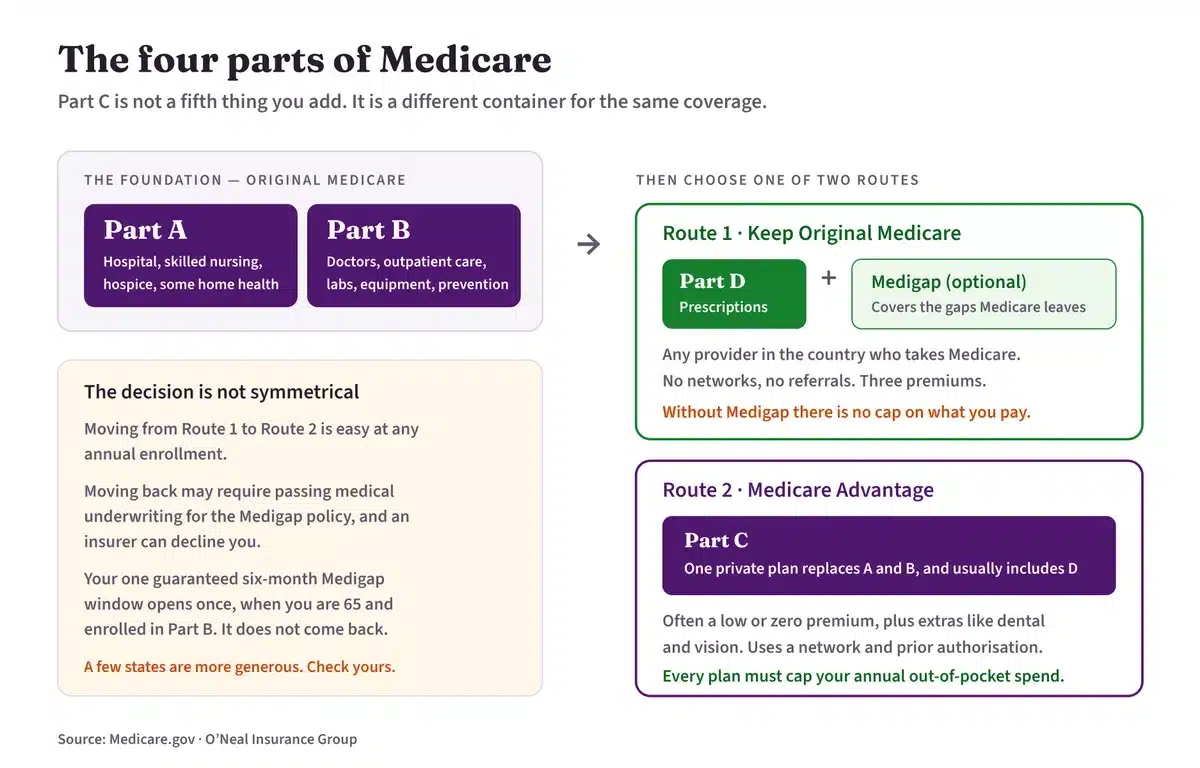
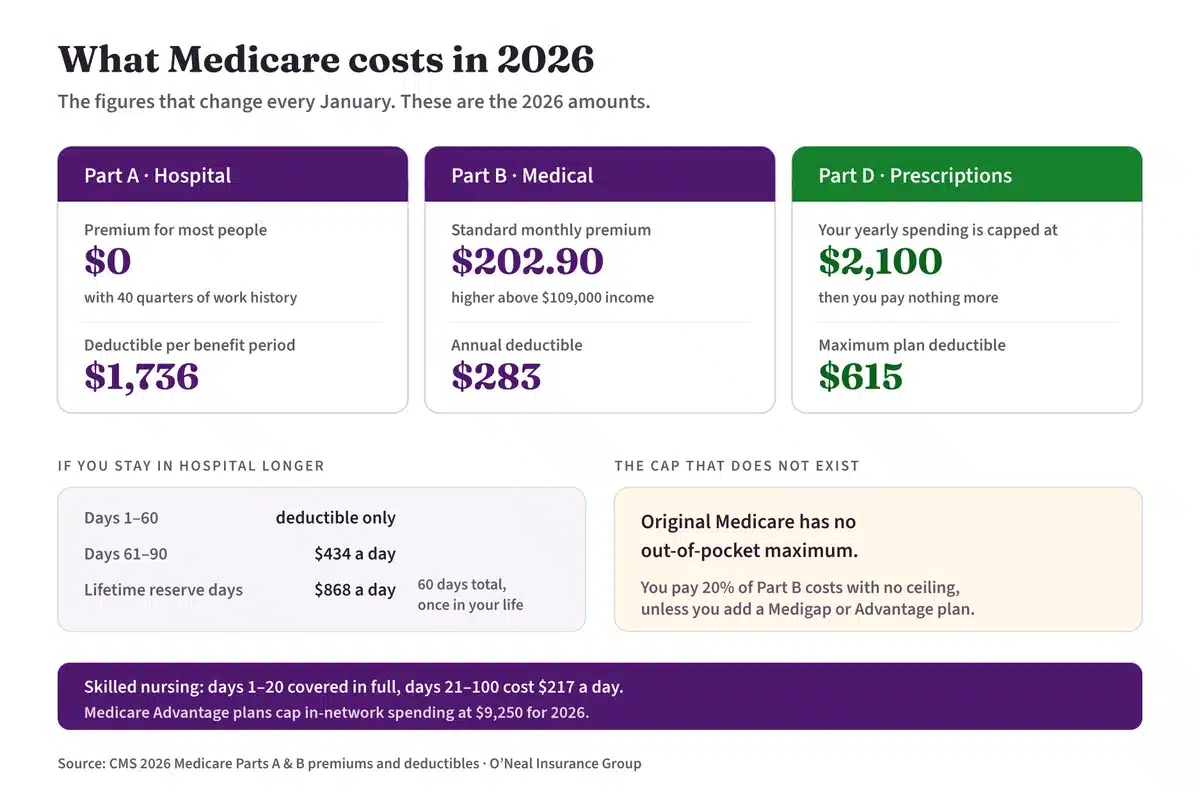
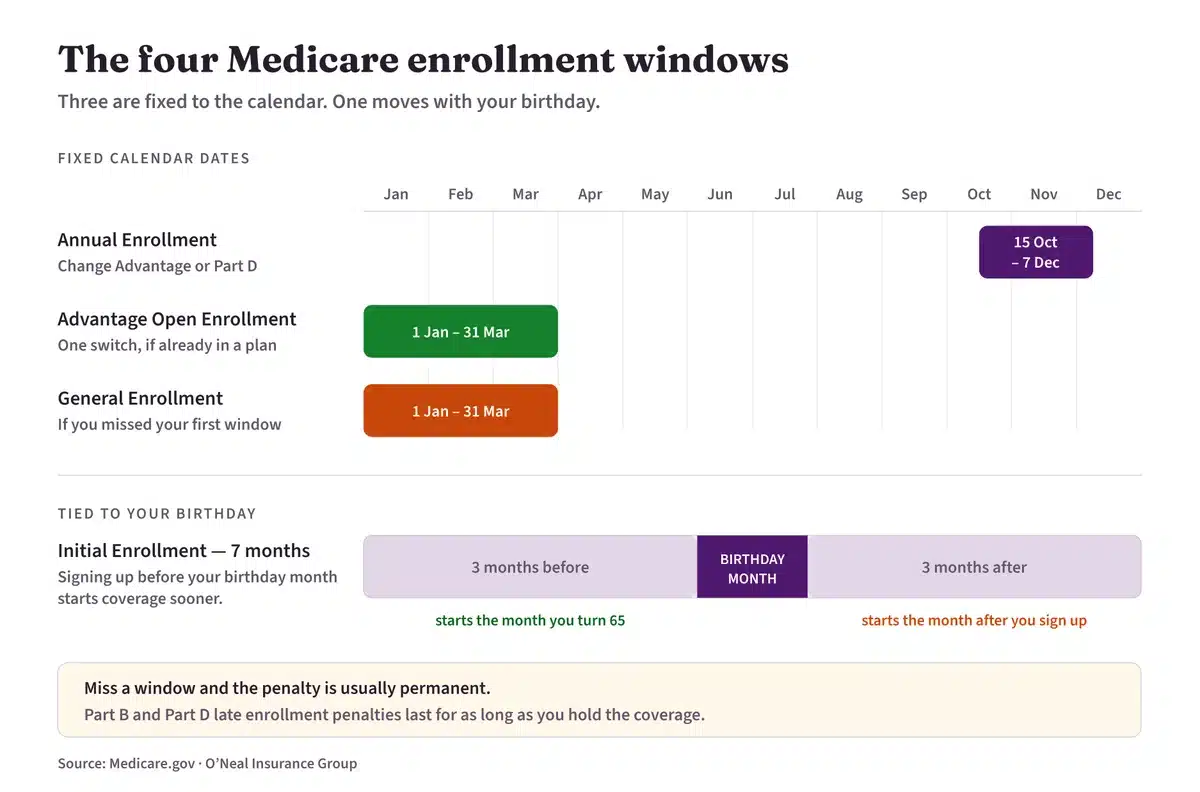
Medicare reference charts
The charts below cover the ground most questions start from.
Where to go next after meeting James O’Neal
- How we help — the process, and how the agency is paid
- Which Medicare enrollment window applies to you
- What to bring to a Medicare plan review
- The four offices and areas served
- Book a no-cost appointment
Personal guidance · No additional fee
Book time with James O’Neal
We start with your doctors and your prescriptions, then show you which plans in your county actually keep them.