Medicare Supplement Insurance
Medigap explained in plain language
Medigap, also called Medicare Supplement Insurance, is a private policy that pays a share of what Original Medicare leaves you to pay. It has no network, it works with any provider in the country who accepts Medicare, and it does not include drug coverage. This page explains how Medigap works, what the lettered plans mean, and the one enrollment window that matters most.
What Medigap actually does
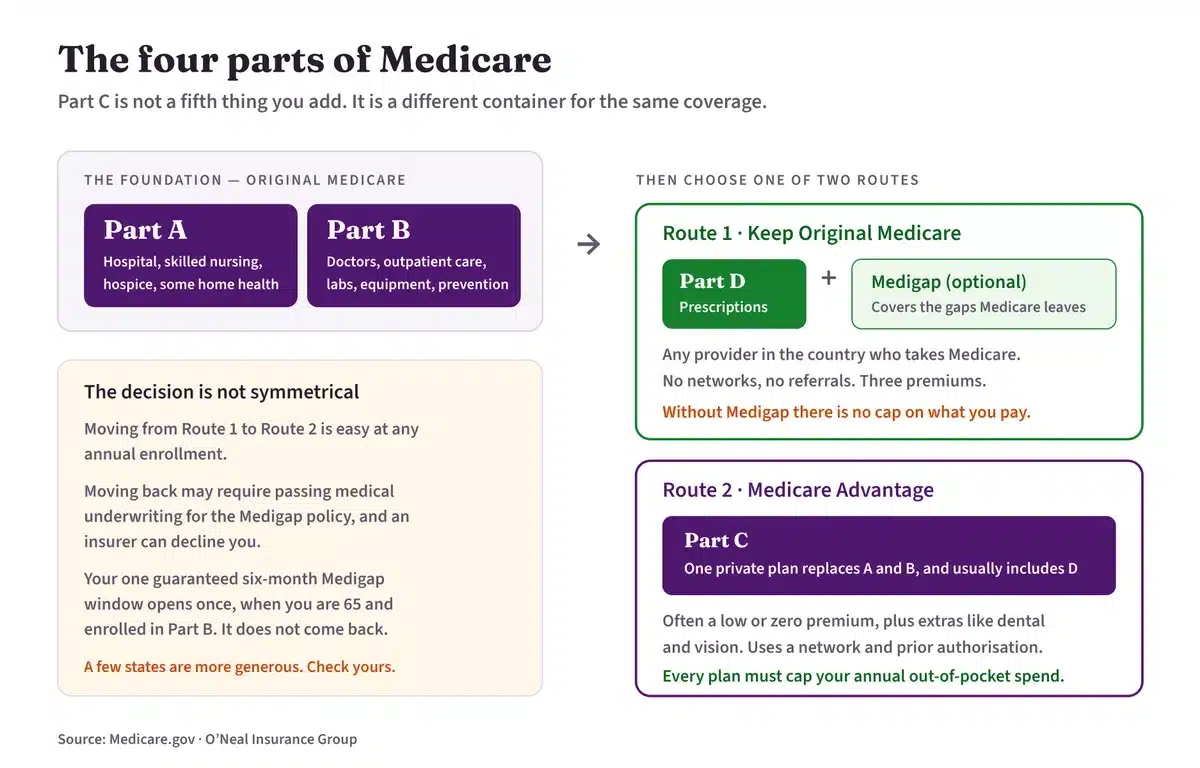
Original Medicare pays most of your hospital and medical costs, but not all of them. It leaves deductibles, coinsurance and copayments, and it has no cap on what you can pay in a bad year.
A Medigap policy fills part of that gap. Depending on the plan letter, it can cover the Part A hospital deductible, the 20 percent Part B coinsurance, hospital costs beyond what Medicare covers, and more.
You keep Original Medicare as your primary coverage. Medicare pays first, then the Medigap policy pays its share of what remains. You are not leaving Medicare, and you are not joining a network.
What Medigap does not cover
- Prescription drugs, which require a separate Part D plan
- Routine dental, vision and hearing care
- Hearing aids and eyeglasses
- Long-term care and custodial nursing home care
- Private-duty nursing
The lettered Medigap plans
Medigap plans are standardized by federal law. A plan with a given letter covers the same benefits no matter which company sells it, in every state except Massachusetts, Minnesota and Wisconsin, which standardize differently.
That standardization is the most useful thing to understand. Two companies selling the identical plan letter are selling identical coverage. What differs is the premium, the pricing method, and how the company handles service and rate increases.
The plans most people consider
Plan G
The most comprehensive option available to people newly eligible today. It covers everything Plan F covers except the annual Part B deductible, which you pay yourself.
Plan N
Lower premium than Plan G, in exchange for small copays on some office and emergency department visits, and no coverage of Part B excess charges.
High-deductible Plan G
A much lower premium with a high annual deductible you meet before the policy pays. Suited to people who want protection against a catastrophic year rather than help with routine costs.
Plan F and the 2020 rule
Plan F and high-deductible Plan F are closed to people who became eligible for Medicare on or after January 1, 2020. If you were eligible before that date you may still be able to buy or keep one.
The official comparison of every lettered plan is published at Medicare.gov.
The Medigap window that matters most
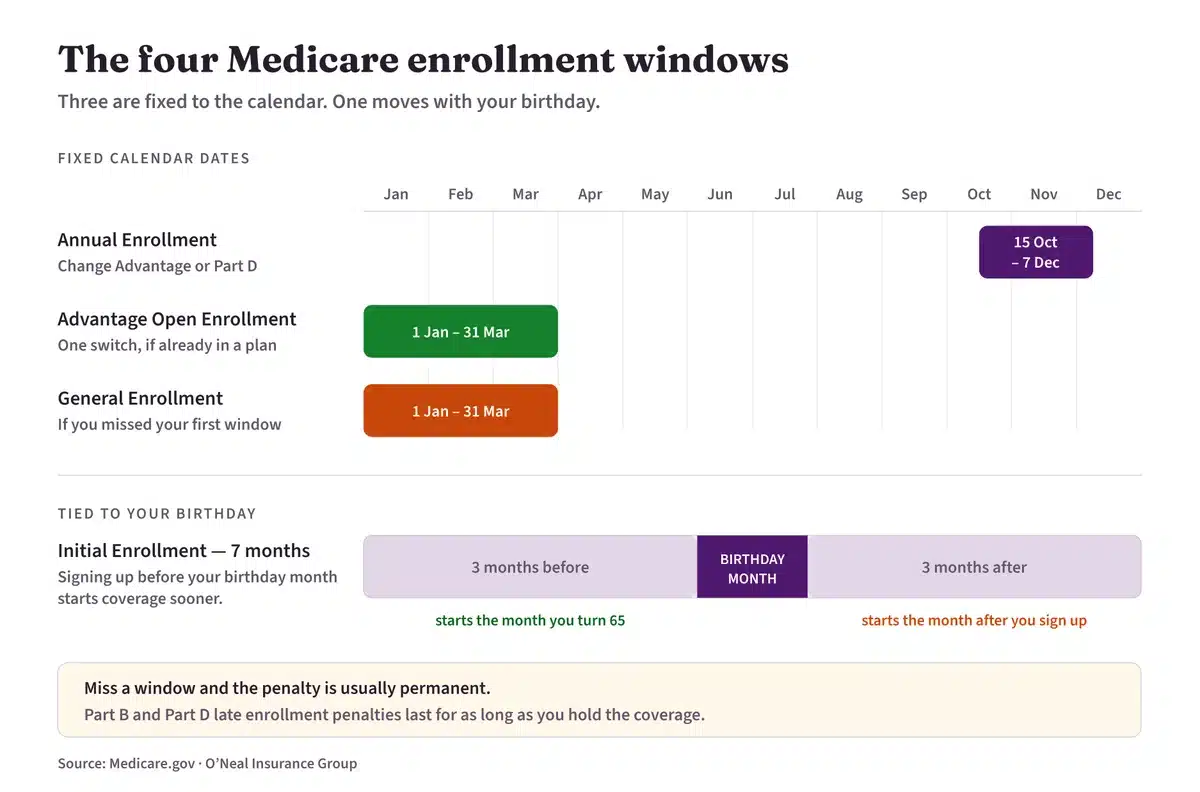
Your Medigap Open Enrollment Period runs six months, beginning the first month you are both 65 or older and enrolled in Part B. It happens once and it does not repeat.
Inside the window
You have a guaranteed right to buy any Medigap policy sold in your state, at the best available rate, regardless of your health. No medical questions.
Outside the window
In most states a company can require medical underwriting and can decline you or charge more. Health history you had no control over can close the door.
State rules that reopen the door
Some states give Medigap policyholders an annual opportunity to change policies without underwriting. These rules vary, and advice written for one state can be wrong in another.
Nevada
Under Assembly Bill 250, effective January 1, 2022, Nevada gives a 60-day window beginning the first day of your birth month to move to a policy with the same or lesser benefits. Nevada allows you to change insurance companies.
Illinois
Since 2022, Illinois gives policyholders aged 65 to 75 a 45-day window beginning on their birthday to move to a policy with equal or lesser benefits, but only with their current insurer or an affiliate.
Illinois also provides a six-month guaranteed-issue window for beneficiaries under 65, plus an annual guaranteed-issue opportunity with Blue Cross and Blue Shield of Illinois from October 15 through December 7.
Roughly a dozen and a half states now have some form of birthday or anniversary rule. If yours does, missing it usually means waiting a full year.
How Medigap premiums are priced
Because the coverage is standardized, price and pricing method are what actually differ between companies. There are three approaches, and the difference compounds over decades.
Community-rated
Everyone pays the same premium regardless of age. Rates still rise with inflation and claims, but not because you got older.
Issue-age-rated
The premium is based on your age when you bought the policy and does not increase because you age. Buying earlier locks in a lower base.
Attained-age-rated
The premium is based on your current age and rises as you get older. These often look cheapest at 65 and become the most expensive later.
A policy that is cheapest today is not necessarily cheapest over twenty years. Ask which method a company uses before comparing quotes, because otherwise you are comparing numbers that behave differently over time.
Medigap compared with Medicare Advantage
You cannot hold both. Choosing one is choosing a structure, not just a plan, and it is the decision most worth slowing down for.
Where Medigap is usually stronger
- Any provider nationwide who accepts Medicare, with no network to check
- Predictable costs, with little or nothing to pay at the point of care
- Travel, including months spent in another state
- No referrals and no prior authorization from a plan
Where Medicare Advantage is usually stronger
- Lower monthly premium, often zero
- Drug coverage usually built in rather than purchased separately
- Extra benefits such as dental, vision, hearing and over-the-counter allowances
- A single card and one plan coordinating your care
Our Medicare Advantage page covers that side in detail, and the extra benefits page explains how to value the perks honestly.
You still need Part D with Medigap
Medigap policies sold today do not include prescription coverage. If you take any medication, you need a standalone Part D plan alongside your policy.
Skipping Part D when you have no other creditable drug coverage creates a late enrollment penalty that is added to your premium permanently, calculated from how many months you went without.
Our Part D page explains the coverage stages and what to check on a formulary.
Ask before you decide
Frequently asked questions about Medigap
Does Medigap have a network?
No. A Medigap policy works with any provider in the country who accepts Medicare. There is no network, no service area, and no referrals.
Can I have Medigap and Medicare Advantage together?
No. They are alternative structures, and a Medigap policy cannot be used to pay Medicare Advantage cost sharing.
Is Plan F still available?
Only to people who became eligible for Medicare before January 1, 2020. Anyone newly eligible after that date generally looks at Plan G or Plan N instead.
Can I be turned down for a Medigap policy?
Not during your six-month Medigap Open Enrollment Period or in a guaranteed-issue situation. Outside those, most states allow medical underwriting.
Is the same plan letter identical at every company?
Yes, the benefits are standardized by federal law, except in Massachusetts, Minnesota and Wisconsin. Premiums and pricing methods differ.
Does your help cost anything?
No additional fee is charged to you for O’Neal Insurance Group’s guidance. Agents may be compensated by an insurance carrier when an enrollment occurs.
How to compare quotes properly
Because the benefits are fixed by law, comparing policies is unusually straightforward once you know what to ask. Four questions do most of the work.
- Which pricing method does the company use: community-rated, issue-age, or attained-age?
- What has the company’s rate increase history looked like over the past several years?
- Is there a household or multi-policy discount you qualify for?
- How long has the company sold this product in your state?
A quote is a snapshot. The pricing method and the rate history tell you what the premium will look like in ten years, which matters far more on a policy most people keep for decades.
When a supplement is the wrong choice
An honest page has to include this. A Medigap policy is not right for everyone, and there are situations where it is clearly the weaker option.
When the premium does not fit the budget
A policy you cannot comfortably afford every month is worse than a network plan you can. Dropping coverage later, after underwriting has become a barrier, is the outcome to avoid.
When you qualify for Medicaid
If you have both Medicare and Medicaid, a Dual Eligible Special Needs Plan usually covers more than a supplement would, at far lower cost. Our dual eligibility page explains why.
When you have retiree or VA coverage
Employer retiree coverage or VA health care may already fill much of the same gap. Buying a supplement on top can mean paying twice for one benefit. Our veterans page covers the VA side.
Important: Medigap availability, premiums and state rules vary by state, by company and by year. Nothing on this page is an offer of coverage or a statement of what any specific policy provides. We do not offer every plan available in your area. Any information we provide is limited to those plans we do offer in your area. Please contact Medicare.gov, 1-800-MEDICARE, or your State Health Insurance Assistance Program to get information on all of your options.
Official resource
The 2026 figures behind the plan letters
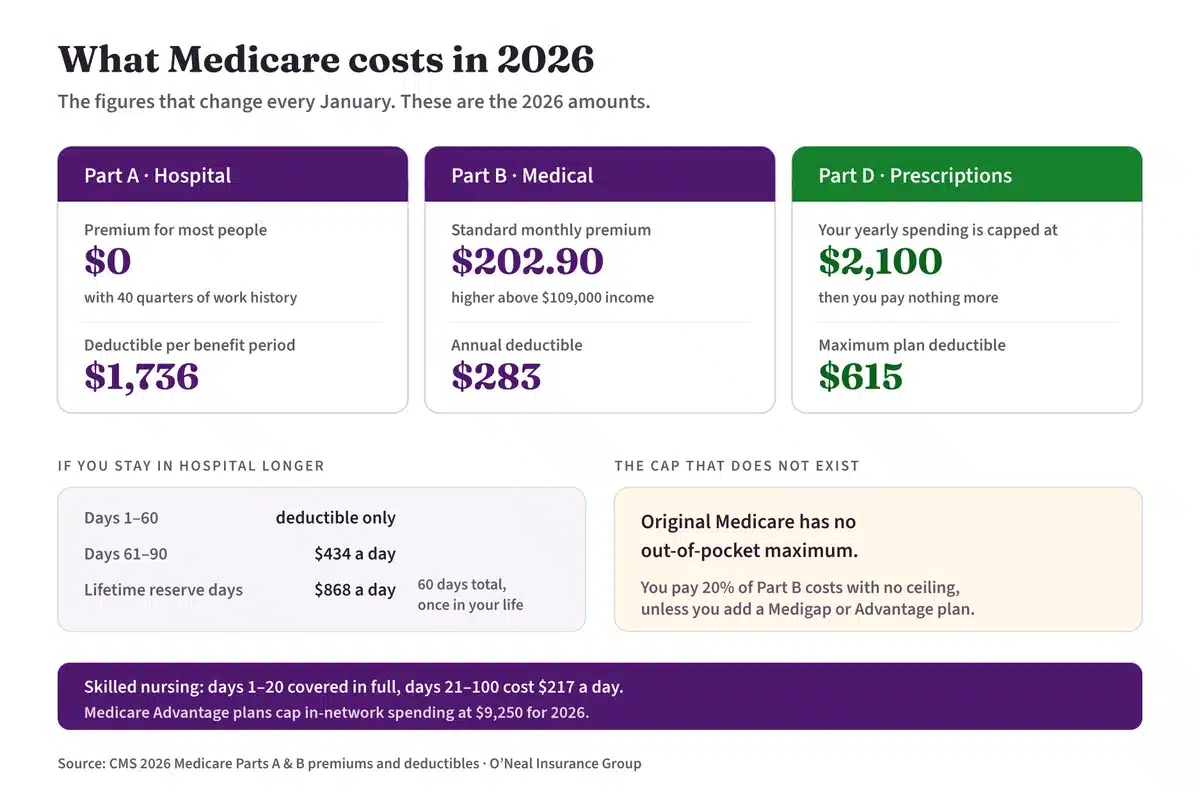
Every insurer selling a given letter must provide identical benefits, so these numbers are the same wherever you buy. For 2026 the Part B deductible is $283 and the Part A hospital deductible is $1,736 per benefit period.
Plan F covers the Part B deductible; Plan G does not. That is the only difference between them, and it is why Plan G is usually the better value once you compare the premium gap against $283 a year.
Plan N differs from Plan G in exactly two ways: copayments of up to $20 for some office visits and up to $50 for emergency department visits that do not result in an inpatient admission, and no coverage of Part B excess charges. Note both qualifiers — “up to” is a ceiling rather than a flat charge, and the emergency copay is waived if you are admitted.
The high-deductible version of Plan G carries a $2,950 deductible for 2026 before the policy pays. Plans K and L work differently again, covering a percentage rather than the full amount, with 2026 out-of-pocket limits of $8,000 and $4,000 respectively. Plans C and F, including high-deductible F, are closed to anyone who first became eligible for Medicare on or after January 1, 2020.
The state rules that reopen the door, in detail
Your federal Medigap open enrollment runs six months from the point you are both 65 and enrolled in Part B, and it does not come back. A number of states are more generous, and the differences between them are larger than most summaries admit.
Year-round or annual rights. Connecticut and New York require Medigap to be available continuously, with community rating. Massachusetts offers continuous open enrollment. Washington lets existing policyholders move among most plan letters at any time without health screening. Rhode Island added an annual guaranteed-issue window during the Annual Enrollment Period in 2025.
Birthday rules reopen a short window each year, and the terms differ in ways that decide whether they are useful to you. Nevada gives at least 60 days from the first of your birth month and lets you change insurer. Illinois gives 45 days from your birthday but only between ages 65 and 75, and restricts you to the same company or its affiliates. Kentucky requires you to move to a different insurer. Louisiana restricts you to the same one. California, Idaho, Oklahoma and Oregon each run their own version, and Indiana added one effective January 1, 2026.
Missouri runs an anniversary rule instead, tied to your policy date rather than your birthday, letting you move to the same lettered plan with a different company.
Two cautions. Most of these windows restrict you to equal or lesser benefits, so they are a route to a cheaper policy rather than a richer one. And these rules change every legislative session — commercial comparison sites are frequently a year or two behind, particularly on whether you may change carrier. Check your own state insurance department rather than a list.
A claim about excess charges that does not hold up
Whether Plan G’s excess-charge coverage is worth paying for depends on how common excess charges are where you live. You will read almost everywhere that eight states prohibit them: Connecticut, Massachusetts, Minnesota, New York, Ohio, Pennsylvania, Rhode Island and Vermont.
Checked against the statutes, that list is wrong in both directions. Ohio and Minnesota have genuine broad prohibitions. Massachusetts imposes one on physicians as a licensing condition. New York caps the charge rather than banning it and exempts office and home visits. Vermont’s ban carries exceptions covering most office visits and higher-income beneficiaries. Connecticut’s own counseling program publishes a fact sheet telling beneficiaries excess charges can be billed there.
The wider context is reassuring either way. MedPAC reported that 98 percent of clinicians billing the physician fee schedule were participating providers in 2023, and 99.7 percent of claims in 2024 were paid at the standard rate. Excess charges are uncommon rather than impossible, and behavioural health is where they turn up most.
The question to ask about pricing
Two Medigap policies of the same letter cover identically, so price and rate history are the whole comparison. Ask which of three methods the insurer uses: community rating charges everyone the same, issue-age rating locks the price to your age when you bought, and attained-age rating starts cheapest and climbs as you get older.
The lowest quote at 65 is frequently an attained-age policy that becomes the most expensive one by 80, and switching later means answering health questions. Ask for the insurer’s rate increase history for your state over the last five years, and treat an enrollment discount that quietly shrinks each year as part of the price rather than a bonus.
Check the source, then ask for personal help
Educational information is general. A licensed agent can help with plan comparisons; agents do not provide medical, legal, or official eligibility advice.
Personal guidance · No additional fee
Find out which Medigap plan letter fits your situation
We compare the same plan letter across the companies available to you, and explain how each one prices it over time.
Medicare reference charts
One more chart that answers a question we get constantly.